

On 22 October, senior HR, L&D, wellbeing and inclusion professionals gathered at the Royal College of Surgeons of England in London for the third annual FAIRER Conference. Discussions centred on three themes: the link between inclusion and business performance, people-centred leadership, and sustaining employee wellbeing and performance. Speakers and delegates explored how organisations can connect fairness, inclusion and wellbeing with business performance – and turn good intentions into meaningful change. Read the biggest takeaways from the day.
The day was opened by FAIRER Managing Director Dan Robertson, who set out three key principles as a reminder of the outcomes we are all working to achieve: fairness and opportunities for all, belonging and workplace safety, and harmony and corporate cohesion. The challenge for organisations is to bring these together, creating workplaces where people can contribute as individuals while building the relationships and shared purpose needed to work effectively across differences.
Dan outlined five balancing acts for leaders:
- Mainstreaming fairness while retaining targeted support for specific communities
- Connecting the moral case for inclusion and wellbeing with performance goals
- Navigating the tension between strategic silence and active allyship
- Keeping leadership human-centred in a technology- and AI-driven world
- Recognising community differences while encouraging meaningful connections between groups.
Theme 1: The performance paradox: how fair and inclusive people strategies drive productivity and profit
The business case for fairness and inclusion goes beyond proving that diversity increases profit; we must understand the conditions people need to perform well and stay – and the organisational costs when those conditions are missing.
Julie Dennis, Head of Inclusive Workplace Strategy & Policy at Acas, highlighted the importance of addressing workplace conflict early, particularly when disability, reasonable adjustments and management practices are involved. She challenged the assumption that conflict is always caused by an individual’s performance or behaviour, as sometimes the underlying problem is that people have not been given the right support or conversations to succeed.
Acas’s 2025 research found that 68% of people whose disability had a major impact on their daily life had experienced workplace conflict in the previous 12 months, compared with 44% of working-age people overall. The findings highlight the importance of effective support – such as reasonable adjustments – and fair management practices.
Managers need the confidence to have difficult conversations before problems become formal grievances. That includes understanding reasonable adjustments, applying policies fairly, providing appropriate support and managing performance consistently. Organisations should also ensure probation, disciplinary and grievance processes are fair and properly followed.
Employees are increasingly using AI tools to help draft grievance letters, but some disputes may be resolved much earlier through an honest conversation. At FAIRER, clients often come to us for conflict resolution training, but by then it’s often too late. We encourage our clients to have those difficult conversations earlier.
Measure the experience, not just representation
Organisations need to look beyond representation data to understand whether employees feel included and have a sense of belonging. Representation data can show who is joining an organisation, but it cannot tell leaders whether those people feel they belong or are considering leaving. Start by examining employee feedback, attrition, progression and engagement across different groups, then make leaders accountable for acting on what the data reveals.
Ken Kittoe, Head of Talent Acquisition, UK & Lloyds at AXA XL, described the “vibe check” as one of his approaches to employee listening: “It's walking around the business, speaking to people, asking how they're doing and understanding how the organisation actually feels. The data tells you what's happening. The conversations tell you why.” Read more about AXA XL’s approach to inclusion.
Moving beyond representation data means looking at where people encounter barriers and what organisations can change. Joanne Sime, Head of Global Inclusion, Wellbeing & Culture at TUI, shared how the organisation has approached neuroinclusive travel by considering the customer journey from beginning to end. Its work has included neurodiversity awareness learning, reviewing pre-travel policies, introducing neuro-inclusive airport representatives to help customers assess accessibility, and piloting a sensory space at an adults-only resort that is open to everyone. Read more about TUI’s approach to inclusion.
Five key takeaways for HR, inclusion, L&D and wellbeing practitioners
- Resolve conflict early. Equip managers to discuss concerns, performance and reasonable adjustments before problems escalate into formal grievances.
- Connect inclusion to business priorities. Identify the barriers affecting employees and explain how addressing them supports organisational objectives and performance.
- Review policies and processes. Examine recruitment, progression, performance management and other employee touchpoints to identify where policies create unnecessary barriers.
- Measure employee experience. Combine representation data with feedback, retention, progression and engagement measures to understand differences between employee groups.
- Make leaders accountable for inclusion. Give managers and senior leaders ownership of the culture and employee outcomes they influence, rather than leaving inclusion solely to specialist teams.
Theme 2: Placing people at the centre of performance-driven and inclusive work cultures
A high-performance culture depends on the behaviours that leaders reward, the opportunities people receive and whether employees feel able to contribute without having to hide parts of themselves.
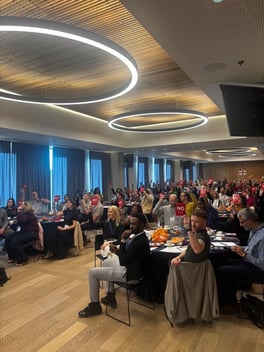
Alice MacDonald, Global DEI Consultant at FAIRER, asked delegates whether their organisation’s
leaders would know which employee groups had the least positive experience at work. The majority of the audience indicated that they would not. Yet, when asked whether their organisation could demonstrate that leadership intent translated into employee impact, the majority said yes.
The contrast highlights a challenge that we often see with our clients. Organisations may have policies, targets and commitments in place without having a clear picture of how employees experience them. A reasonable adjustments process, for example, may exist on paper but be difficult to navigate in practice. A recruitment policy may promise fairness while inconsistent hiring behaviours undermine it.
Alice described this gap through the concept of the “leadership shadow”. “We talk at FAIRER a lot about the leadership shadow – what leaders say, do and ignore has an impact, as well as what HR reinforces through policies and processes,” she explained.
Turning leadership intentions into employee experience
To build trust, leaders need to move beyond simply inviting feedback; they need to explain how decisions are made, apply policies consistently, acknowledge concerns and be honest about what can and cannot change. Listening does not mean every request can be granted, but explaining the reasons for a decision and showing what action is possible can help preserve trust.
Adris Mohammed, Vice President HR at Capgemini, described how the organisation uses employee networks as “communities of influence”, rather than seeing them only as communities of interest. These groups provide a space for people to connect and share experiences, alongside a direct line to the executive board so their insights can inform people strategy. Capgemini also uses a personal passport to help employees communicate how the organisation can support their careers, reinforcing the idea that treating everyone the same does not necessarily give everyone what they need to succeed.
Head of Talent, Culture and Inclusion at giffgaff, Ian Tomney-Bell, discounted the common idea of bringing your authentic self to work, instead promoting the idea of bringing your “audacious” self to work. He described changes to giffgaff’s recruitment – designed to broaden access to talent – such as working with specialist partners, involving diverse hiring managers, standardising interview questions and benchmarks, and improving communications and onboarding. The organisation also introduced a manager guide and new-starter guide, alongside eight affinity groups. Read more about giffgaff’s approach to inclusion.
The leadership paradox
FAIRER’s Global DEI Consultant Barry Boffy MBE challenged delegates to examine the gap between a leader’s intentions and the impact of their behaviour. Support, challenge and consistency can all be valuable, but each can also have unintended consequences. For example, too much support may create dependency; challenge without sufficient support can create pressure; and consistency can become inflexibility when it prevents leaders from adapting to different needs.
Examples of leadership intention vs impact
|
Leader’s intention |
Potential impact |
|
High support |
Dependency |
|
High challenge |
Pressure |
|
Consistency |
Inflexibility |
|
Speed |
Cognitive overload |
|
Inclusion |
Pressure to conform |
Our audience poll found that 75% of delegates believed “I treat everyone the same” was the riskiest leadership motto among the options presented, despite often being well-intentioned. Equal treatment may sound fair, but it can overlook the unique barriers people face and the adjustments they need to contribute on equal terms.
Five key takeaways for HR, inclusion, L&D and wellbeing practitioners
- Test leadership intentions against employee experience. Ask employees how leadership behaviours and organisational policies affect them, and look for differences between groups.
- Give employee networks influence. Provide networks with a clear purpose, recognition and direct routes to decision-makers so their insights can inform organisational strategy.
- Remove barriers from recruitment. Standardise assessment criteria, widen talent pools and review whether selection processes reward genuine capability or familiarity.
- Make decision-making more transparent. Explain how decisions are reached, acknowledge employee concerns and communicate what can change and why.
- Adapt leadership approaches to individual needs. Recognise that treating everyone the same can create unequal outcomes. Equip managers to balance support, challenge and consistency according to the circumstances.
Theme 3: Sustaining employee energy and performance in challenging times
Wellbeing is often discussed as an individual responsibility, but at FAIRER, we challenge organisations to look at the working conditions that create or undermine it. Workload, management behaviour, psychological safety and exclusion can all affect whether people have the energy and capacity to perform sustainably.
Hannah Pearsall, Co-Founder at Pivotal Thread and Non-Executive Director at MHFA, used the job demands-resources model to explain the relationship between work and wellbeing. Job demands might include tight deadlines, high workloads and customer complaints. Resources include autonomy, the skills needed to do the job, supportive management, flexibility and clear objectives.
Job Demands-Resources Model
|
When job demands are... |
And job resources are... |
Likely impact on wellbeing |
|
High |
Low |
Increased stress, burnout, absenteeism, and reduced wellbeing |
|
High |
High |
Demands remain challenging but are manageable, supporting resilience and engagement |
|
Low |
Low |
Reduced stress but potentially lower motivation and engagement |
|
Low |
High |
Highest likelihood of positive wellbeing, motivation, job satisfaction, and performance |
When demands persistently outweigh resources, people can struggle to recover. Burnout is different from everyday workplace stress; it is the result of chronic stress that has not been managed effectively, with symptoms including exhaustion, cynicism and reduced professional efficacy.
The implication is that organisations cannot rely on individual resilience initiatives to compensate for poorly designed work. As Hannah explained, “Trying to mitigate burnout at an organisation level is like giving someone an umbrella with a broken spoke.” Her practical advice was to investigate what helps people manage workplace demands, rather than simply offering another resilience workshop to teams already under pressure. That means reviewing workload, control, support and the way work is organised.
Recognise the cognitive cost of exclusion
The conference also highlighted how exclusion can affect people’s capacity to do their jobs. When employees are managing identity-based stressors, anticipating bias or questioning whether it is safe to speak up, they are using mental energy that could otherwise be directed towards their work – sometimes described as a “cognitive load” or “emotional tax”.
MIT Sloan Management Review found that toxic corporate culture was 10.4 times more powerful than compensation in predicting employee turnover. The findings highlight the importance of respectful, inclusive workplaces in retaining employees. Additionally, MHFA England found that 49% of working adults did not feel comfortable expressing their needs at work, while 15% said they had made preventable mistakes because they felt unsafe speaking up.
The consequences of poor workplace culture are not limited to individual wellbeing. If people self-censor or decide not to pursue opportunities because they expect an unfair outcome, organisations lose valuable information and capability. Psychological safety is therefore critical, as it can influence whether risks are identified and employees can contribute fully.
Leaders can also help reduce the pressure to self-censor by actively inviting challenge and thanking people who raise risks. Other practical ideas included establishing a meeting-free time each day, giving senior colleagues opportunities to share personal experiences, and encouraging employees – and leaders – to take up flexible working options. If employees are routinely working through lunch or absorbing ever-increasing demands, wellbeing messages will have limited effect unless the underlying conditions change.
Supporting employees to return to work – and stay there
The Keep Britain Working review, led by Sir Charlie Mayfield, found that employees absent from work for four to six weeks had a 96% chance of returning. However, this fell to less than 50% after more than a year of absence, highlighting how the likelihood of returning to work decreases the longer someone is away.
We asked delegates whether they knew how many employees who had returned from sickness absence were still in work six months later. No one raised their hand, highlighting that return-to-work rates alone don't tell the full story. Employers need to consider whether people are able to sustain their return and remain in work over the longer term.
Natasha Frangos, Managing Partner at HaysMac, described her practice of “walking the floor” as a way to gain a better understanding of employee experience. By spending time in shared spaces and observing the atmosphere, she gets a real-time sense of how people are feeling and can pick up on concerns that might not surface through formal feedback channels. Read more about HaysMac’s approach to inclusion.
Five key takeaways for HR, inclusion, L&D and wellbeing practitioners
- Review job demands and resources. Examine workload, autonomy, management support and job design before relying on individual resilience training to address workplace stress.
- Identify and address barriers to speaking up. Ask employees where they feel unable to express concerns or request support, examine patterns in feedback and take action to address them.
- Apply behavioural standards consistently. Hold all employees, including high performers and senior leaders, accountable for behaviour that damages colleagues or workplace culture.
- Build recovery into everyday working practices. Review meeting schedules, workload expectations and opportunities for breaks, and encourage leaders to model sustainable working habits.
- Measure sustained return-to-work outcomes. Look beyond absence and initial return-to-work figures to understand whether employees remain well and are able to stay in work over the longer term.
The consistent message throughout the conference was that fairness, inclusion and wellbeing must work together. This requires leaders to consider how their decisions and organisational practices affect people’s day-to-day experience at work.
FAIRER helps organisations turn these principles into practical change through training, leadership development and consultancy. Programmes including Inclusive Leadership, Conscious Inclusion, and Driving Business Performance through Inclusion and Wellbeing help organisations dismantle barriers and connect people priorities with organisational performance.
Our consultants work with organisations to develop inclusionion and culture strategies, assess workplace culture and identify where existing policies and practices may be creating barriers. We use these insights to help leaders set clear priorities and put practical changes in place.
The next step is to identify where your organisation could make a difference. Get in touch to book a complimentary call with one of our inclusion and culture specialists to discuss your priorities and explore how FAIRER can help.