

The UK's proposed pay transparency laws could change the way organisations approach recruitment, requiring employers to disclose salary information in job adverts or provide it to candidates before interview where no advert is used. The proposals, which are currently out for consultation and are expected to be introduced through future legislation across England, Wales and Scotland, would bring the UK closer to approaches already adopted in parts of the EU, North America and elsewhere.
On paper, it's a win for fairness. Candidates gain a clearer understanding of what a role is worth, reducing the risk that pay is influenced by negotiating confidence, previous salary history or unconscious bias. Greater transparency can also help narrow gender, ethnicity and disability pay gaps by creating more consistent and defensible pay decisions.
For organisations, this change goes beyond just adding a salary range to a job advert. Pay transparency has the potential to expose how organisations value roles, make pay decisions and attract talent – and, in doing so, unveil inequalities that may previously have gone unnoticed.
That said, experience elsewhere shows that transparency only works when it’s backed by robust pay practices. Some organisations have published salary bands so wide that they provide little meaningful information, while others have faced difficult conversations when employees discover unexplained differences in pay between similar roles. The employers that have navigated this best are those that have invested in clear job grading, consistent pay frameworks and transparent progression criteria before publishing salaries.
The lesson from countries and regions that have gone first is that salary disclosure is not the end goal, it's a catalyst. Transparency shines a light on how pay decisions are made. If those decisions are fair, it builds trust and strengthens employer credibility. If they're not, it quickly exposes the gaps. As the UK prepares to implement these changes, organisations have an opportunity to get ahead by reviewing pay structures now rather than waiting for the law to force the conversation.
Why is pay transparency gaining momentum?
“Pay transparency is becoming increasingly common globally,” says Global DEI Consultant Alice MacDonald. “The approach can take different forms, from publishing salary ranges on job adverts to making internal pay bands available to employees. At FAIRER, we understand that pay transparency is not defined by a single level or degree. Rather, it sits on a spectrum, with organisations choosing different levels of transparency depending on legislation and their own pay strategy,” she adds.
The case for greater transparency is closely linked to the gender pay gap and wider inequalities in the workplace. The UK's gender pay gap, for example, sits at 12.8%. While the causes of pay inequality are complex, organisational structures play an important role. “Where men are disproportionately represented in senior, higher-paid positions and women are more heavily represented in lower-paid roles, these patterns contribute to the overall gender pay gap”, says Alice.
Pay transparency can help challenge some of the practices that allow these disparities to persist. One example is salary history. In some US jurisdictions where pay transparency legislation has been introduced, employers cannot ask candidates how much they currently earn. Instead, candidates are told what the role pays and can decide whether they want to progress.
This approach can help to level the playing field. Rather than basing an individual's new salary on what they earned in their previous role, organisations can focus on what the job is worth and the skills required to do it. This is particularly relevant where someone may have been historically underpaid and could otherwise carry that disadvantage from one role to the next.
There is also evidence that transparency can influence who applies. Research from Handshake found that employers received 13% more applications from Black students when annual salary was disclosed in the role description. Indeed data found that jobs on Indeed with salary information have 15% more started applications per impression. Failing to communicate pay may mean organisations are losing transparency while also narrowing their talent pool.
What does the new pay transparency law mean for organisations?
The introduction of pay transparency could force organisations to examine the foundations beneath their recruitment and reward practices. Publishing a salary range is relatively straightforward. Explaining why that range exists – and why one person is paid differently from another – requires much more work.
Organisations need to be confident that their pay bands are clear, that roles are appropriately evaluated and that employees are being paid at the right level. Before introducing greater transparency, organisations should audit their current workforce and identify any discrepancies. Where differences cannot be explained by legitimate factors such as skills, experience or role requirements, employers may need to address them before publishing salary information.
It’s also important to ensure that advertised salary bands accurately reflect what the role will pay. A range such as £100,000 to £150,000 may technically be transparent, but if the gap is so wide that candidates cannot understand where they are likely to sit within it, the information provides limited value.
Organisations should also consider total compensation. Salary is only one part of the overall package, and job adverts can explain other benefits and reasons why someone might want to join the organisation.
The changes will also require recruitment teams and hiring managers to adapt. If organisations move away from asking candidates what they currently earn and instead focus on the value of the role and the skills required to perform it, recruiters and hiring managers will need to understand how to have those conversations confidently.
Training is therefore critical. Anyone involved in hiring should understand what pay transparency means, why the organisation is introducing it, how it connects to the gender pay gap, and why it matters for people, business and employer brand.
That said, pay transparency should be incorporated as part of a wider HR initiative. It is an opportunity to look more broadly at whether recruitment processes are genuinely inclusive.
Five ways to embed inclusion in your recruitment
Pay transparency can help create a fairer starting point, but it does not remove the other barriers that can influence who applies, who progresses and who gets hired. Organisations should use this opportunity to reflect on the entire recruitment journey.
1. Make job adverts clear and inclusive
Writing inclusive job descriptions is essential to reaching a diverse range of applicants. Start by focusing on what the role actually involves. Be specific about tasks and responsibilities rather than relying on vague descriptions such as asking for a "strong leader". Most importantly, include an accurate salary range. Avoid ranges so broad that they offer little meaningful information, and explain the wider benefits package where possible.
2. Challenge bias at the shortlisting stage
Recruiters and hiring managers are gatekeepers to DEI, and unconscious bias can influence decisions from the earliest stages of recruitment. As FAIRER Consulting MD Dan Robertson explains, “First impressions formed through a CV, LinkedIn profile or social media can influence future interactions and decisions. Confirmation bias can then lead decision-makers to overlook information that challenges their initial impression."
Affinity bias can also influence perceptions of likeability and competence, with factors such as appearance, education, accent and work history affecting how candidates are assessed. Structured, criteria-based assessments, anonymised CVs and diverse panels can help reduce the influence of these biases. Candidates should be assessed against clear, job-related criteria rather than assumptions about who will "fit" an existing team or organisational culture. If AI is used to sift applications, organisations should also remember that its output should always be monitored for potential bias.
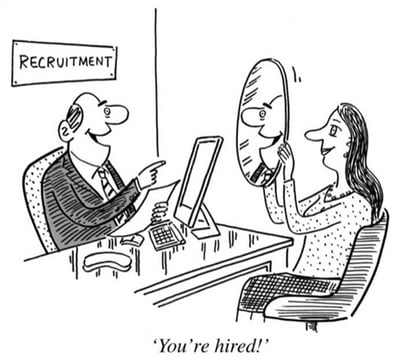 Caption: Affinity bias occurs when we favour candidates who feel familiar or similar to ourselves, potentially overlooking equally qualified talent from different backgrounds.
3. Make interviews structured and skills-based
Only 28% of UK employers trained all their interviewers on their legal obligations and objective interview practice, according to CIPD. Fewer than one in five had taken steps to reduce bias by testing the wording of job adverts or checking that tests were valid, reliable and objective. Structured interviews can help address this gap.
Use the same format and questions for candidates and assess everyone against the same clear criteria. Compare candidates in batches rather than making decisions one person at a time, and use a consistent scoring system.
Interviewers should also be trained to recognise how first impressions, shared interests and communication styles can influence their judgement. Where possible, use visibly diverse interview panels, while ensuring representation is meaningful rather than tokenistic. Panel members should be empowered to contribute to the decision-making process and should not be expected to represent an entire demographic group.
4. Build accessibility and adjustments into the process
An inclusive recruitment process should not require candidates to overcome unnecessary barriers simply to demonstrate their skills. Be proactive in offering adjustments. This could include providing interview questions in advance, allowing additional time to answer questions, using live captions during video interviews, choosing accessible venues or arranging an interpreter.
Consider the needs of neurodivergent applicants and candidates with mental or physical health conditions, and ask candidates directly whether there are adjustments that would help them participate fully. The principle is simple: inclusion should not be an afterthought. It should be built into the process from the beginning.
5. Measure who progresses – and who doesn't
Organisations cannot understand whether recruitment is equitable by looking only at the diversity of their applicants or new hires. Track data across the recruitment funnel, including applications, shortlisting, assessments, interviews and offers. Look for points where particular groups are disproportionately dropping out.
The same principle applies to the candidate experience. The recruitment process shapes your employer brand, whether someone is hired or not.
This is particularly important given the gap that can exist between an employer's promise and the reality experienced by employees. Research from Hays found that 44% of professionals have left a role in the first year because it didn't match the expectations they gained during the job application process. Inclusive recruitment cannot stop at the job advert; the experience candidates are promised must reflect the experience they will actually have.
Pay transparency is a catalyst, not the end goal
The introduction of pay transparency legislation could represent a significant step towards fairer recruitment, but publishing salary information alone will not create an inclusive organisation.
The real opportunity is to use transparency as a catalyst to examine how roles are valued, how pay decisions are made and how candidates move through the recruitment process.
Organisations that get ahead of the changes can begin by reviewing their pay structures, auditing existing discrepancies, training hiring managers and recruitment teams, and embedding inclusion throughout the recruitment journey.
Let's work together
As pay transparency becomes an increasingly important part of the UK's approach to workplace fairness, now is the time to understand where your organisation stands.
FAIRER's bespoke DEI audits can help you identify potential biases and inequalities across your policies and processes, uncover unseen barriers and turn those insights into practical, measurable actions. Alternatively, get in touch to find out how FAIRER Consulting can help your organisation build a fairer, more inclusive workplace.